
Choosing Between the F-250 and F-350: Which Super Duty Fits Your Job
Posted at Wed, Dec 2, 2026 1:00 PM
THE SHORT ANSWER
The F-250 and F-350 share the same cab styles and the same 6.7-liter diesel, but the F-350 rides on a heavier frame with available dual rear wheels for bigger towing and payload jobs. Most pickup and trailer work around Sayville fits comfortably inside the F-250 lineup, which keeps the price and the ride more manageable. Sayville Ford can match your actual towing needs to the right trim on either truck.
If you haul trailers, tow equipment, or run a job site anywhere between Sayville and the rest of Suffolk County, you've probably stood in a lot and wondered whether you actually need an F-350 or whether an F-250 covers it. Sayville Ford sees this question every week, and the honest answer depends less on which truck sounds tougher and more on what you're actually going to load, tow, and drive every day. Here's how the two Super Duty trucks compare, and where the line between them really falls.
IN THIS POST
- What Separates the F-250 from the F-350
- The F-250 Lineup: Trims and What You Get
- Power Under the Hood
- Cab and Box Configurations
- 2WD vs 4WD: Matching Drivetrain to Your Jobs
- Where the F-350 Steps In
- Payload and Towing: Picking the Right Truck for the Work
- Pricing and Trim Ladder: Finding Your Sweet Spot
- Key takeaways
What Separates the F-250 from the F-350
Ford builds the F-250 and F-350 on the same Super Duty platform, with the same cab choices and the same diesel engine under the hood. The real difference sits underneath: frame strength, axle rating, and how much weight the truck is engineered to carry or pull safely.
The F-350 is the step up for the heaviest jobs. It's available with dual rear wheels, which spread the load across four tires instead of two and add stability when a trailer gets long or a bed gets full. If your work regularly pushes toward the top of what a half-ton or even a standard heavy-duty truck can handle, that's where the F-350 starts to make sense.
For a lot of contractors, landscapers, and trailer owners, though, the F-250 does the job without the extra size and cost. The trick is matching the truck to the actual work, not the biggest number on the window sticker.
The F-250 Lineup: Trims and What You Get

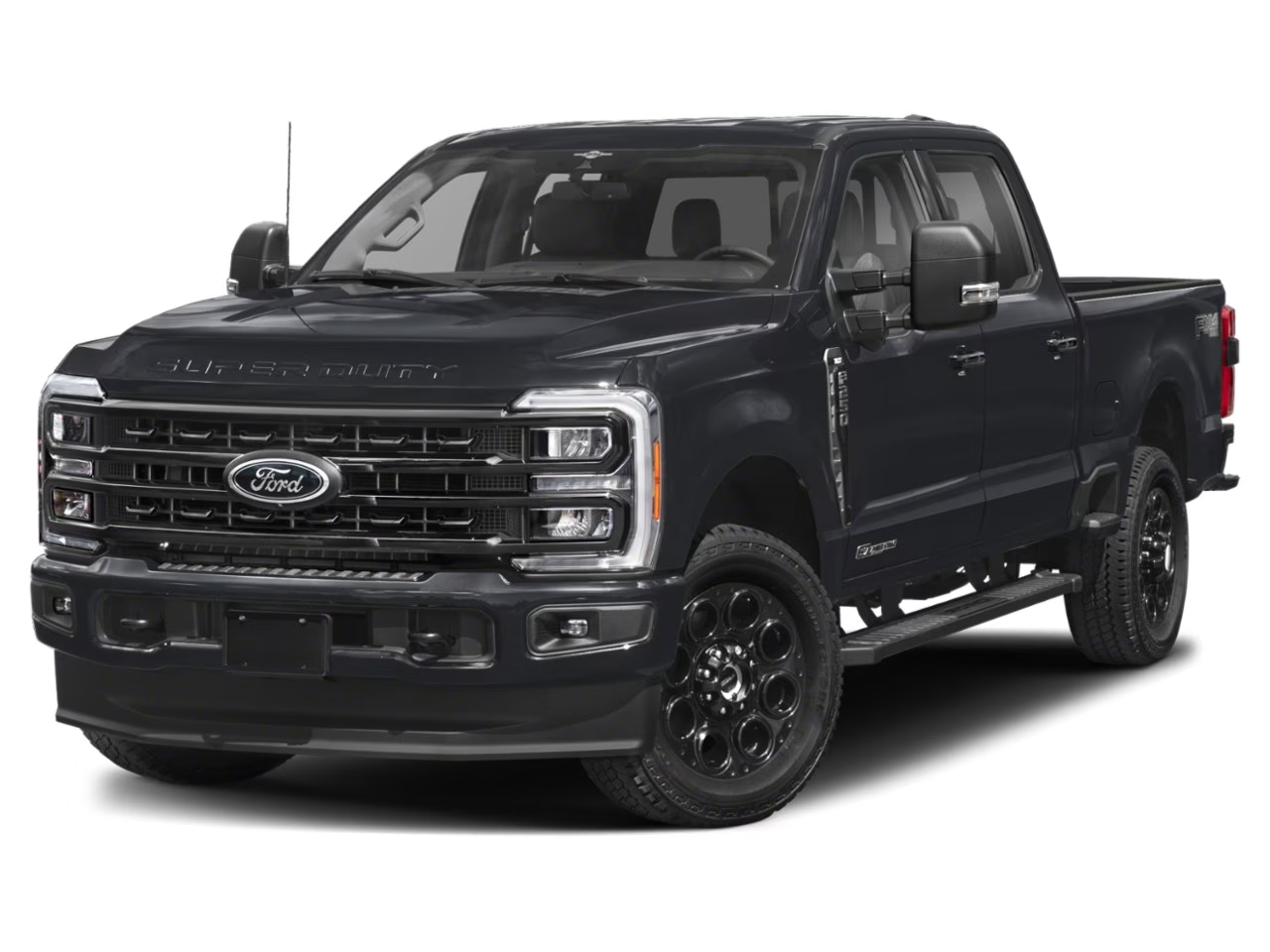
The 2027 F-250 runs through three trim families, and each one adds a bit more comfort and equipment without changing the engine underneath. XL is the work-truck starting point, XLT adds more convenience features, and LARIAT moves into a more upscale cab.
Trim Highlights
- XL (2WD) starts at $46,125; XL (4WD) runs $48,925
- XLT (2WD) starts at $49,425; XLT (4WD) runs $52,225
- LARIAT Crew Cab is available in 6.75' and 8' box lengths, starting at $63,125
Regular cab XL and XLT trims also come with roughly 11.6 cubic feet of storage room behind the front seats, which is handy for tools, gear, or anything you don't want sitting exposed in the bed. Take a look at new F-250 inventory to see which trims we currently have on the lot.
Power Under the Hood

Every 2027 F-250 trim comes with the same 6.7-liter 8-cylinder diesel, producing 420 horsepower at 5,350 RPM. That consistency is worth knowing: you're not giving up power by choosing a lower trim or a 2WD setup over 4WD.
What changes trim to trim is comfort, cab size, and drivetrain, not the engine's output. So the decision between XL, XLT, and LARIAT really comes down to what's inside the cab and how you plan to use the truck day to day, not whether one hauls or tows better than another at the engine level.
That same engine carries through regular cab and crew cab versions alike, so a work crew running a basic XL has access to the same pulling power as someone in a loaded LARIAT.
Cab and Box Configurations
The F-250 is available as a regular cab or a Crew Cab, and the Crew Cab comes with a choice of 6.75-foot or 8-foot box length. Picking between them usually comes down to what you're hauling and where you're parking it.
A shorter box is easier to maneuver on job sites, in driveways, and around tight Sayville streets, while the longer 8-foot box gives more room for lumber, ladders, or bulky equipment that needs to lie flat. Crew Cab models add a full back seat, which matters if you're regularly bringing a crew along rather than driving solo.
Regular cab XL trims, by contrast, keep things simple and a bit more affordable, which some owners prefer if the truck is strictly for work and the bed does the heavy lifting anyway.
2WD vs 4WD: Matching Drivetrain to Your Jobs
Every F-250 trim comes in both rear-wheel drive and 4-wheel drive, and the price gap between them is consistent, generally landing around $2,500 to $3,000 depending on trim. The question is whether you actually need it.
If your routes stay on paved roads and parking lots, 2WD keeps the price down without costing you capability. If you're driving onto job sites, through snow on back roads, or pulling a trailer off pavement, 4WD earns its keep when traction gets unpredictable.
Long Island winters aren't brutal, but they're not nothing either, and a lot of local buyers lean toward 4WD simply for the peace of mind on icy mornings. Check current offers to see if there's extra room in the budget to step up to 4WD on the trim you want.
Where the F-350 Steps In
The F-350 earns its place when a job genuinely needs more than the F-250 is built to carry or pull. It shares the Super Duty cab and engine family, but its frame, axles, and available dual rear wheel setup are built around higher payload and towing demands.
That makes it the right call for owners regularly pulling heavier gooseneck or fifth-wheel trailers, hauling dense materials like stone or concrete, or running equipment that pushes weight limits on a routine basis. It's not about wanting more truck for the sake of it; it's about the math on what you're actually loading.
If you're not sure which side of that line your work falls on, our team can talk through your typical trailer weight and cargo load and help you figure out honestly whether the F-250 covers it or the F-350 is worth the step up. We also carry used Super Duty trucks if a prior-year F-350 fits the budget better than a new one.
Payload and Towing: Picking the Right Truck for the Work
Payload and towing capacity are where the F-250 and F-350 diverge the most, even though they share an engine. The heavier frame and axle setup on the F-350 give it more room before you hit a weight limit, which matters if you're close to the edge on a regular basis rather than occasionally.
For most pickup truck owners, trailer towing stays well within what the F-250 is built to handle, whether that's a boat out of a Great South Bay marina, a car hauler, or a landscaping trailer loaded with equipment. The F-250's 420-hp diesel gives it plenty of pulling power for day-to-day work without the extra size of a dually.
If you're trading in a truck that's starting to feel maxed out on a regular job, value your trade and we'll help figure out whether stepping up to the F-350 actually changes your day-to-day, or whether a well-equipped F-250 solves the problem just as well.
Pricing and Trim Ladder: Finding Your Sweet Spot
F-250 pricing starts at $46,125 for an XL 2WD and climbs to $63,325 for a LARIAT Crew Cab with the 8-foot box, which gives you a wide range to work with depending on how much cab room and equipment you want. Mid-pack trims like the XLT Crew Cab land in the $54,000 to $57,000 range, which is where a lot of working buyers end up settling.
The jump from XL to XLT brings more cab comfort and convenience features without changing the drivetrain, while LARIAT moves into a noticeably more finished interior. None of that changes the engine or power output, so the climb up the trim ladder is really about how much truck you want to live in versus work out of.
Our financing team can walk through monthly payment scenarios across trims so you can see where your budget actually lands before you commit to a specific build.
Where
5686 Sunrise Hwy
Sayville, NY
Call
KEY TAKEAWAYS
- The F-250 and F-350 share the same engine and cab choices but differ in frame strength and payload capacity.
- F-250 trims run from XL 2WD at $46,125 up to LARIAT Crew Cab at $63,325, all with the 420-hp 6.7L diesel.
- Dual rear wheels and a heavier frame set the F-350 apart for the heaviest trailers and loads.
FAQ
Common questions
Does the F-350 tow more than the F-250?
Generally, yes, the F-350's heavier frame and available dual rear wheels are built around higher towing and payload limits than the F-250. How much more depends on the specific trim and configuration you're comparing, so it's worth talking through your actual trailer weight with our team.
Is the F-250 engine weaker than the F-350's?
Not necessarily. The 2027 F-250 comes with a 6.7-liter 8-cylinder diesel producing 420 horsepower at 5,350 RPM across every trim, and the F-350 shares that same engine family. The difference between the two trucks is mostly in frame and axle capacity, not raw engine output.
What's the price difference between 2WD and 4WD on the F-250?
Across F-250 trims, 4-wheel drive typically adds somewhere in the range of $2,500 to $3,000 over the equivalent 2WD trim. For example, XL 2WD starts at $46,125 while XL 4WD starts at $48,925.
Which F-250 trim is the best value for a work truck?
A lot of buyers land on the XLT, since it adds comfort and convenience over the base XL without the full step up to LARIAT pricing. XLT trims start at $49,425 for 2WD and $52,225 for 4WD, with Crew Cab versions available if you need rear seating.
Can I finance or trade in my current truck toward an F-250 or F-350?
Yes, our finance team can walk through payment options for either truck, and we're happy to appraise your current vehicle toward the purchase. There's no guarantee on approval terms, but we'll walk you through realistic numbers based on your situation.
Want to see it in person?
Browse what is on the lot right now, or come by and see it in person.
Or call (631) 589-4800 · 5686 Sunrise Hwy, Sayville